
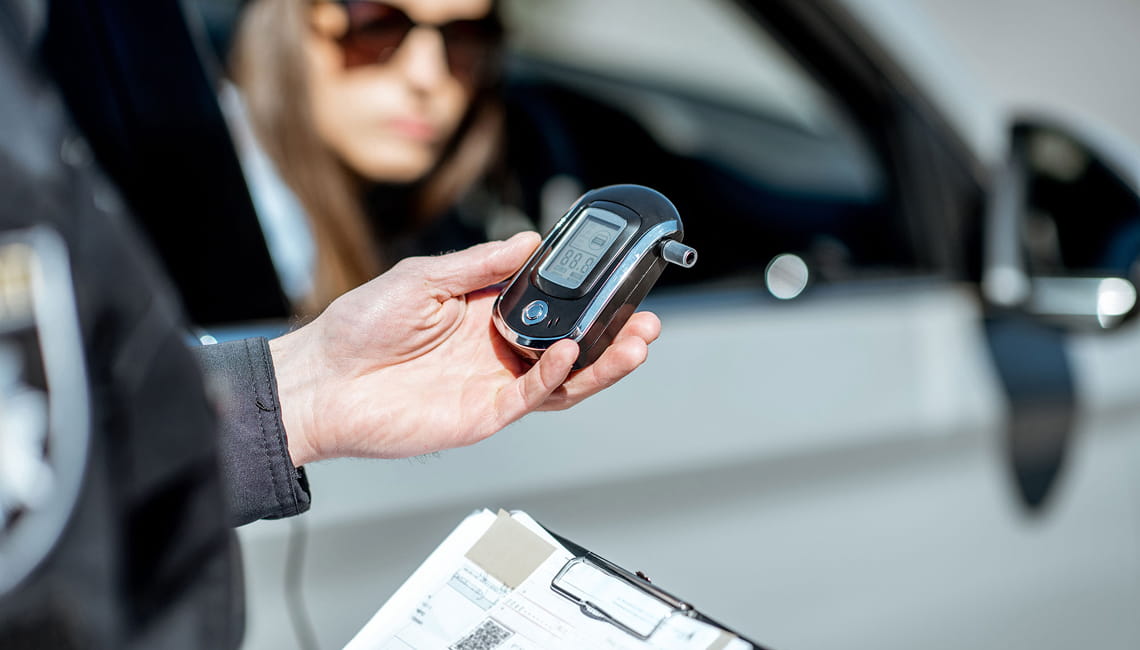
Charged with drink driving? Why the breathalyser reading may not be the end of the story
It is one of the most common things we hear from people charged with drink driving:
“I was over the limit. Surely there is nothing a solicitor can do?”
It is an understandable conclusion.
You have been stopped or arrested. You have given a specimen. A machine has produced a number. You have been charged and told to attend court.
It can feel as though the case has already been decided.
But it hasn’t.
A breath, blood or urine reading is obviously an important part of a drink-driving prosecution, but it is not necessarily the whole case. Before deciding whether to plead guilty, the real question is whether the prosecution can prove every element of the offence against you and whether the evidence upon which it relies is admissible and reliable.
That is a very different question from simply asking: “Was I over the limit?”
What does the prosecution actually have to prove?
In England and Wales, section 5 of the Road Traffic Act 1988 creates the offence of driving or attempting to drive a motor vehicle on a road or other public place while the proportion of alcohol in your breath, blood or urine exceeds the prescribed limit.
The legal limit in England and Wales is 35 microgrammes of alcohol in 100 millilitres of breath.
So imagine your charge sheet shows a breath reading of 47.
Understandably, your first reaction may be:
“47 is higher than 35. I’m guilty.”
But criminal cases do not work quite that simply.
The prosecution still needs evidence capable of proving the offence. Depending upon the circumstances, questions may arise about who was driving, where the alleged driving took place, what evidence exists of driving, the taking of the specimen and the reliability and admissibility of the prosecution evidence.
The CPS prosecution guidance addresses a range of evidential issues arising in drink-driving cases, including evidential breath-testing instruments, the taking of samples, unused material, post-driving consumption and defence challenges.
That is why we believe the evidence should dictate the advice, rather than assumptions being made from the reading alone.
“But I admitted I had been driving”
That may be important. But again, it needs to be considered in context.
Questions can arise about precisely what was said, when it was said, to whom it was said and what other evidence exists.
In some cases, proving that the defendant was actually driving can become a significant issue.
There is also a separate offence of being “in charge” of a vehicle whilst over the prescribed limit. Driving and being in charge are not the same offence and the sentencing consequences can be very different.
This does not mean that somebody charged with drink driving can simply ask for their charge to be changed to being in charge.
However, in some cases, there can be an opportunity for a discussion with the CPS to agree to substitute a drink driving charge with a lesser charge.
What if I drank alcohol after driving?
This is another situation in which people sometimes assume that the alcohol reading obtained by the police automatically establishes what their alcohol level was when they were driving.
But what if some or all of the alcohol was consumed afterwards?
Perhaps there was an accident, you arrived home and consumed alcohol before the police subsequently attended. Or there was a significant period between the alleged driving and the specimen being obtained.
Post-driving consumption is recognised in CPS prosecution guidance as an evidential issue that can arise in drink-driving cases.
It does not follow that saying “I drank afterwards” provides an automatic defence. Far from it.
But where post-driving consumption genuinely occurred, it is an issue that may require proper investigation and potentially expert evidence rather than being dismissed simply because a later specimen was above the prescribed limit.
Can the police procedure be challenged?
Potentially, yes.
There are statutory provisions governing the requirement for and taking of specimens, and police drink-drive investigations ordinarily involve a formal evidential procedure.
A specialist solicitor should therefore consider the evidence relating to that procedure rather than simply looking at the final number.
But there is an important word of caution here.
Not every mistake means a prosecution collapses.
Searching through paperwork hoping to find an inconsequential technical error is very different from identifying a genuine evidential or legal problem with the prosecution case.
Good advice sometimes means telling a client that an apparent irregularity does not provide them with a viable defence.
What about pleading guilty?

Specialist legal advice can also be key for those clients who choose to accept the charge and plead guilty.
For driving or attempting to drive whilst over the prescribed limit, conviction ordinarily means a driving disqualification of at least 12 months. A second relevant conviction within 10 years can result in a minimum three-year ban. Depending upon the seriousness of the offence, the court also has other sentencing powers.
The court may offer the Drink-Drive Rehabilitation Scheme to an eligible defendant. Successful completion of the course can reduce the period of disqualification by up to 25%.
So if there is no realistic defence, the focus changes.
The objective is then to give sensible advice about the plea, likely sentence, mitigation and any steps that can appropriately be taken before the sentencing hearing.
And sometimes we will tell somebody that they probably don’t need us.
If somebody simply wants to plead guilty to a relatively straightforward allegation and there is nothing unusual about the evidence or circumstances, paying for specialist representation may not always represent value for money.
We would rather tell somebody that honestly than persuade them to spend money unnecessarily.
Why does losing a licence matter so much?
For many people charged with drink driving, the fine is not what keeps them awake at night.
It is the driving ban.
Losing a licence can have profound consequences. Someone may need to drive for their job, travel significant distances to work, operate a business or depend upon their car for family responsibilities.
Unfortunately, however serious those consequences might be, a court cannot simply dispense with the statutory minimum disqualification following an ordinary conviction for driving with excess alcohol because losing the licence will create hardship.
That makes it particularly important to understand the legal position before deciding how to plead.
What about very high readings?
There is another potential consequence that people sometimes overlook.
The DVLA operates a High Risk Offender scheme. This can apply to drivers convicted with particularly high alcohol readings, as well as certain repeat offenders and people in some other specified circumstances.
Being classed as a High Risk Offender can make getting your licence back more complicated.
A High Risk Offender does not simply resume driving when the period of disqualification expires. The driver must satisfy the DVLA that they are medically fit to drive again and undergo the required medical process.
This means that understanding the wider consequences of a conviction can be every bit as important as knowing the likely length of the ban.
So, is it worth getting a specialist drink-driving solicitor?
Not always.
That may sound like a strange thing for a firm of specialist motoring solicitors to say.
But the answer should depend upon the case.
If the evidence is overwhelming, there are no realistically arguable issues and you simply intend to plead guilty and your alcohol reading was within the lowest senrencing bracket, costly specialist representation may not always be proportionate.
However, if keeping your licence is extraordinarily important to you, or if there is something unusual about the allegation, obtaining specialist advice before assuming that you have no option other than pleading guilty may be a very different proposition.
The number can be key but it isn’t the whole case.
A reading of 40, 50, 80 or even higher can understandably dominate somebody’s thinking after they have been charged.
But a number printed on an evidential breath-test record is evidence. It is not, by itself, a conviction.
The job of a specialist motoring lawyer is not to promise that every drink-driving allegation can be successfully defended.
It is to establish whether this one can.
And if it cannot, you deserve to be told that too.
At Geoffrey Miller Solicitors, we have specialised in motoring law since the firm was founded in 2000. Our approach is to investigate the evidence, identify the issues that genuinely matter and give clients realistic advice about their options.
Because pleading guilty after understanding the strength of the evidence is an informed decision.
Pleading guilty simply because you assumed there was nothing anyone could do is something quite different.
Further information
GOV.UK: Drink-driving penalties
https://www.gov.uk/drink-drive-limit
https://www.cps.gov.uk/legal-guidance/road-traffic-drink-and-drug-driving
Sentencing Council: Excess alcohol offences



















Add comment