

In order to convict a defendant of a crime, aside from the specific elements of the offence, one of the most important and basic issues that must be proved is the identity of the offender.
The Crown is responsible for presenting identification evidence in a criminal prosecution. There are many different types of identification evidence permitted. These range from police officers’ or lay witness testimony at court (perhaps the most common in driving cases) to less common visual and forensic evidence (CCTV, footage, police body cam footage and dash cam footage from members of the public, DNA evidence, lineups).
But I was the driver – Isn’t denying this in court a serious offence?
Even if you were the driver of a vehicle, for the prosecution to prove this to the criminal standard (beyond reasonable doubt) may not be as straightforward as it sounds.
We will NEVER suggest or participate in a defence that involves misleading the court so we are not suggesting in any case that a client should deny driving when they were the driver. This could lead to being prosecuted for the serious charges of perjury or perverting the course of justice.
However, we are often able to challenge a prosecution on the basis that the evidence to prove driving is insufficient. Not because we claim our client was not the driver but because the prosecution have no or insufficient admissible evidence to prove that they were. So, putting the ball back in the court of the prosecution to overcome this hurdle.
The different forms of evidence that could be used to prove an offender’s identity are varied. There are a number of cases and guidelines that consider these in detail. We have explored these below.
Video ID
 Under Annex A of PACE Code D, a video identification will take priority, unless this method of identification is not practicable to arrange or the officer in charge of the investigation considers that another method of identification is more satisfactory.
It is the responsibility of the identification officer to arrange for and ensure the availability of a suitable set of images. It is irrelevant whether they come from the police or from members of the public.
Video identification involves the witness being shown moving images of the suspect and moving images of at least eight other people who resemble the suspect (in age, general appearance and position in life). If the suspect has an unusual physical feature such as a scar or tattoo, efforts should be made to conceal the location of the feature on the image of the suspect or replicate the feature on the other people.
To reduce the number of miscarriages of justice, the Court of Appeal issued guidelines on how video identification should be dealt with in cases involving disputed identification in R v Turnbull (the ‘Turnbull’ guidelines). The guidelines are as follows:
- The judge should direct the jury to closely examine the circumstances of the identification (i.e. how long did the witness observe the suspect for?);
- The judge should warn the jury of the special need for caution before convicting the accused in reliance of the identification. He should particularly make reference to the possibility that a mistaken witness can be a convicting witness;
- If the visual identification is poor, the judge should withdraw the case from the jury;
If these guidelines are not followed and the defendant is convicted wholly or substantially on grounds of identification, this will give rise to ground of appeal (see Ozger below)
CCTV identification
 In the case of Ozger (2022), the defendant was tried and convicted for conspiracy to cause grievous bodily harm with intent and for possession of a firearm with intent to endanger life. He was allowed to appeal the decision on grounds of identification. He alleged that the CCTV that was used by the prosecution to prove their case was poor and incapable of supporting a finding that the appellant was the person involved in the shooting. He based his argument on the fact that one of the police officers had previously mistakenly identified a different person as being the person in the CCTV footage.
The Court of Appeal rejected the defendant’s arguments and confirmed that where the photographic image is sufficiently clear, the jury can compare it with the defendant sitting in the dock. The quality of the video was therefore sufficient to allow the jury to reach their own conclusions guided by ‘quasi Turnbull direction’ as to the risks of mistaken identification and the need to take care when making an identification from a two dimensional video recording.
The Court also added that in this case, the CCTV footage was supported by other material capable of supporting the prosecution case (i.e. the cell site analysis; one of the items in the footage was found at the appellant’s home…). It then accepted that, even though sometimes it would be illegitimate or unsafe to identify someone from CCTV, there was no rigid rule on this.
VIPER lineups
 VIPER lineups or identification parades are methods of identification whereby the witness is shown the suspect in a line of at least eight others who resemble the suspect (in age, height, general appearance and position in life). Efforts need to be made to conceal any distinctive feature of the suspect that cannot be replicated on others and the investigating officer must not be present during the process. Furthermore, the witnesses cannot:
- Communicate with each other about the case;
- See any member of the parade/ suspects before or after the identification parade;
- See or be reminded of any photograph or description of the suspect.
The identification parade must be either recorded (video recording) or a colour photograph must be taken.
Breach of PACE Code D
The police are required to comply with PACE Code D whenever identifying a suspect. Nonetheless, a breach of the Code will not automatically lead to the exclusion of the identification evidence. For instance, s.78 of PACE provides that the identification evidence may be excluded by the court where it is established that the breach was significant or substantial and it resulted in prejudice against the defendant.
Witness Evidence
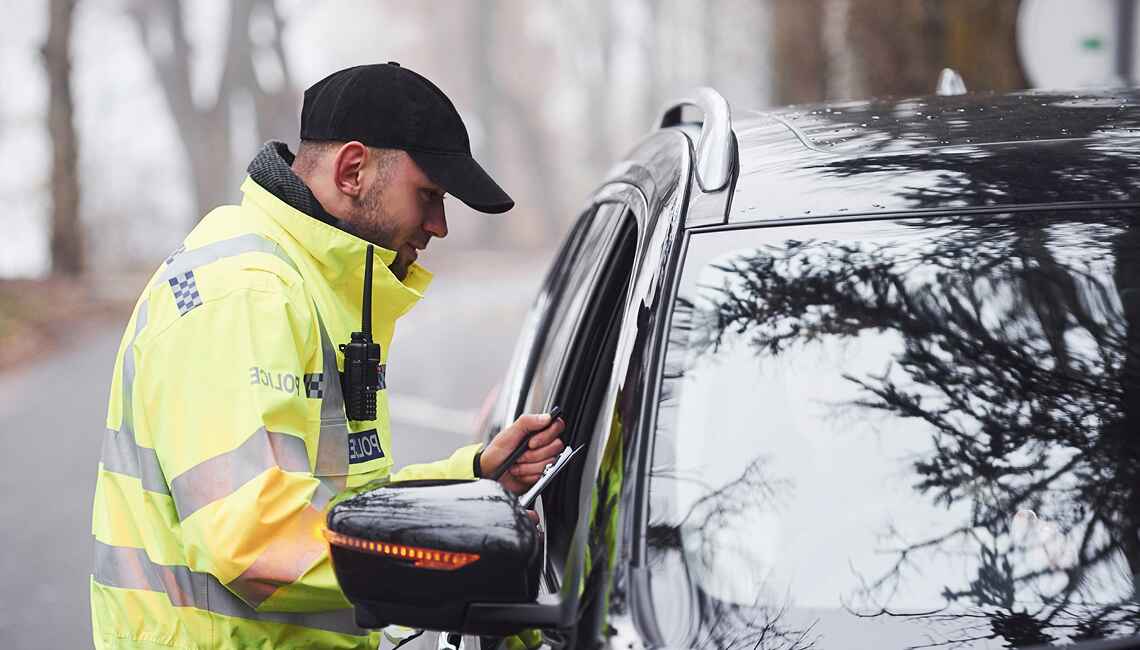
 Police officers are usually the key witnesses to prove identity in driving offence cases, especially when they have witnessed and pulled the driver over for an alleged offence such as drink driving or drug driving or speeding.
But what happens if they reach the scene after the collision and find the driver standing outside the vehicle? You may be found in the vehicle or outside the vehicle but how will they prove who drove the vehicle?
DNA evidence
 The most common DNA evidence that may feature in a driving case is any DNA deposits on an airbag that deploys after a collision.
Contrary to common belief and what you may see on an episode of CSI, a DNA match is not conclusive proof of identity as a forensic expert will generate a ‘random occurrence ratio’ which means that the profile is found in one in every X number of people. The Court of Appeal in Doheny and Adams (1997) specified that it is for the judge to explain the relevance of the random occurrence ratio to the jury in reaching a verdict. The judge also needs to draw the jury’s attention to other evidence that gives significance to the ratio and also any potential conflicting evidence that could lead to the conclusion that the defendant is not responsible for the crime.
The Court of Appeal made it clear in Byron (2015) that if a moveable item is found at the scene that has mixed DNA profiles (i.e. matches to different people), this cannot be the sole basis of a conviction. The Court then went on to affirm that this proposition could also be true in cases where the DNA profile is not mixed. For instance, people can handle an object without depositing their DNA so it is not possible to be certain that the person whose DNA has been found on the object was the only one who touched it.
Nonetheless, if the DNA deposited is a very high match with the defendant then it will be sufficient to raise ‘a case to answer’ (FNC 2015). However, in C (2011), the Court of Appeal
clarified that it is the quality and thus reliability that matters rather than the quantity of the DNA. The quality of the DNA evidence will need to be determined through scientific evaluation.
Police bodycam footage and dash cam
Body cam and dash cam footage will be treated just like CCTV footage so they will be a form of real evidence and they could be used as methods of identification where the identity of the accused is disputed. However, the rules of evidence apply and the footage alone cannot be used in evidence without this being exhibited and adduced at trial.
Speed camera and Automatic Number Plate Recognition (ANPR)
 Fixed speed cameras are usually rear facing so little will be shown of the driver. In fact, when you are caught up in a speeding offence, you normally receive a Notice of Intended Prosecution (NIP) and a letter requiring you to provide or confirm the driver’s details under s.172 of the Road Traffic Act 1988. If you fail to do so within 28 days of service of an NIP, you could be prosecuted for failing to furnish driver details which carries 6 penalty points and a fine of up to £1,000.
Nonetheless, sometimes the image from a speed camera may provide some evidence (e.g. hair, build etc.) depending on the quality of the images captured.
On the other hand, hand held speed cameras and ANPR, will sometimes record facial features of the driver depending on the model of the camera.
If any of these cameras capture a visual image of the driver, then this could be used in court to identify the accused where identity is disputed in minor road traffic cases (dock identification).
Dock identification
Dock identification involve the witness identifying the defendant in the course of a criminal trial. This may only be permitted after the trial judge has considered whether a fair trial would be jeopardised in doing so (Neilly 2012). For instance, dock identifications may be unfair as there is a risk that a witness may be more likely to identify the defendant, not because they are the person they saw committing the offence but because they are the person sitting in the dock and believed to have committed the offence.
If a trial before a jury, they should also be directed as to the danger in relying on such evidence (Turnbull guidelines).
Conclusion
As you can probably tell from this brief overview, there are frequently a number of angles for challenging the validity of identification evidence. We cannot invent a defence but we can use lawful strategies to avoid conviction where proof of identity is unclear.



















Add comment