

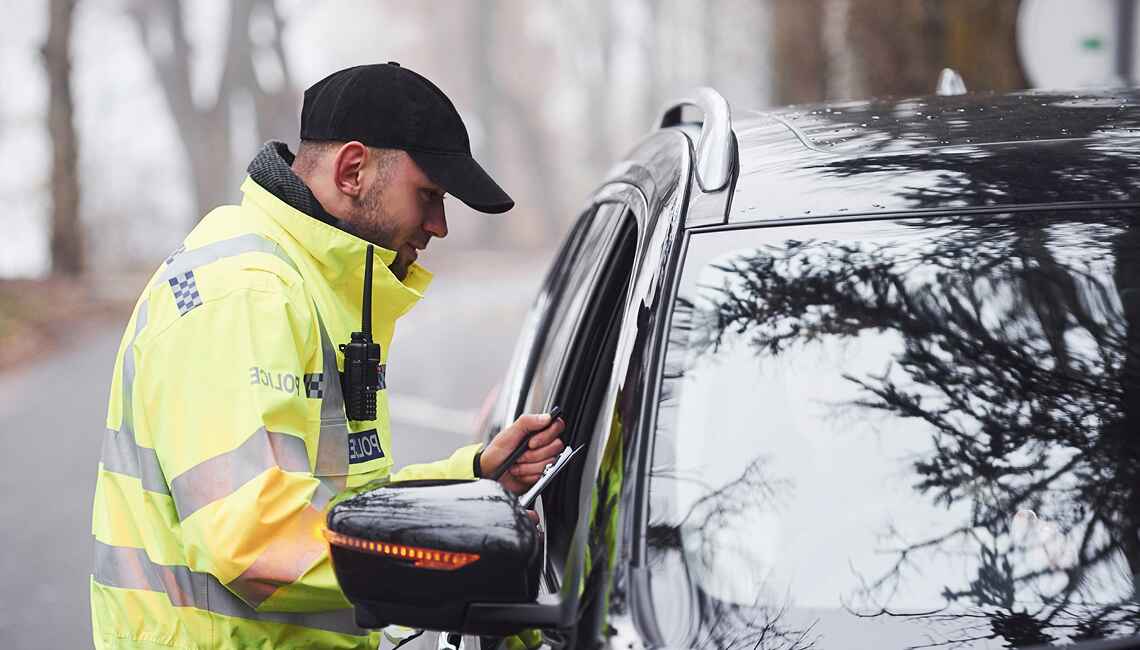
Following a road traffic accident it is standard procedure for the police to require a roadside breath test from the driver(s) involved. A sample may also be required in other circumstances explained below.
Preliminary Breath Test
 Before the police launch a full investigation into whether or not you were over the drink drive limit, they will usually want to conduct a preliminary breath test. This test does not have any evidential value in a criminal court to prove that you were over the drink drive limit but it enables the police to arrest and investigate you further.
The rules on the roadside or preliminary testing are outlined in s.6 of the Road Traffic Act 1988.
The police have the power to breathalyse any driver at the roadside or in a hospital on a hand held device, if they were involved in an accident or have committed a moving traffic offence. In these circumstances, the police do not need to have a reasonable suspicion that you were over the limit to require an initial breath test.
However, if you have been taken to hospital for another reason aside from being in an accident and there is no alleged moving traffic offence leading to the police being involved, then the police must reasonably suspect you to have been driving, attempting to drive or in charge of a vehicle while under the influence of alcohol before they can require a preliminary breath test.
If you fail the preliminary test or refuse to provide a sample and you are taken to hospital, the police will want to obtain a specimen of your blood or urine to establish whether or not you were driving whilst over the legal alcohol limit.
There are numerous aspects of the Hospital Procedure that differ from the rules the police must follow when a detainee is taken to a police station.
Hospital Procedure – Blood Tests
 When procedures are carried out at a hospital, the law provides extra protection to hospital patients due to the fact that the suspect is likely to be in a more vulnerable position if injured or in ill-health. Drink drive procedures are significantly different to standard police station procedures with a number of extra safeguards in favour of the suspect.
Although the police are legally entitled to obtain a blood or urine specimen from a hospital patient who was the driver in a road traffic accident, the law provides for strict procedures to be followed. Quite often the most experienced officer can be unsure of the correct procedures to follow when taking an evidential specimen at a hospital.
Section 9 of the Road Traffic Act 1988 states that whilst a person is a patient at a hospital he will not be required to co-operate with a test unless the doctor in immediate charge of his care has been notified and the doctor does not object to this. Again, this requirement is in place to ensure the vulnerable suspect is treated fairly and the police procedures do not hamper any medical treatment that is required.
Hospital Procedure – Urine Tests
 In the event that a urine sample is requested, the same procedures as stated above must apply, however, urine samples do not need to be taken by a doctor, medical practitioner or health care professional.
It may be the case that the doctor in immediate charge objects to taking a specimen of blood but does not object to taking a specimen of urine.
If this is the case, then two specimens of urine must be taken within the hour. The first of the specimens is discarded and the second is sent for analysis. We often find that there are issues with contamination when a sample of urine is taken, particularly if the same pot is used to take the second specimen as was used for the first specimen. There is likely to be carryover from one sample to another which will cause contamination and may render the sample unreliable.
We also find that our clients do not fully void their bladder when providing the first sample. This is usually due to the fear of being unable to provide a second sample on demand within an hour. Again this can affect the reliability of the second sample as it will not be a true representation of the alcohol in a person’s system should it contain old urine, that should have been discarded with the provision of the first specimen.
Consent
Whether the defendant had the capacity to consent for the sample to be taken is an important issue in most cases. Not only must the consent of the patient be obtained but the consent of the doctor in immediate charge must be provided before any procedures can take place.
In the event of a serious accident, there may be instances where the patient is incapable of consenting because they lack “capacity” to understand the concept of consenting to provide a sample that could be used in evidence against them. A patient may be unconscious, concussed or heavily sedated and therefore unable to provide valid consent. In such cases the consent of the doctor in immediate charge must be obtained in place of the patient’s consent for a sample to be taken.
However, any doctor or health care professional who is responsible for the patient must not be asked to take the sample.
Once the sample has been taken from the patient no further action can be taken with that sample until the patient regains consciousness. When the patient does regain consciousness, the patient must first be informed that a sample has been taken from them, a police constable must then obtain the patient’s permission for the sample to be tested at a laboratory, if the patient provides permission then the sample can be sent to be tested. However, if the patient fails to provide permission, the patient then risks being charge for the separate offence of failing to provide a specimen.
Taking a Specimen
The drink drive procedures are important and in hospital cases they are frequently conducted incorrectly. However, even if the procedures were correctly carried out, there are often issues with the way in which the sample itself was taken by the police doctor or health care professional.
Once the sample after is taken, we will require details of how it was labelled, stored and transported.
If any aspect of this process has not been conducted as it should be, we are likely to argue that the sample obtained is unreliable in a criminal case.
Legal Procedures
If all procedures were followed at the hospital it is still possible that the Crown have failed to adhere to legal procedures throughout the progression of your case. We will request copies of all evidence and of course will obtain our own expert evidence which will be disclosed to the Crown for agreement. Quite often these procedures can be ignored or missed resulting in a potential abuse of process by the Crown.
Points to Remember
- If the doctor provides consent for the police to obtain a specimen but you refuse to provide a sample, this in itself is an offence and you may be prosecuted for failing to provide a specimen.
- The hospital procedure ceases to apply from the moment you are discharged from hospital, even if you are required to return at a later date.
- If you are provided with your sample we advise that you store this in the fridge/freezer and arrange to send this off for independent analysis immediately.
Our Track Record in Hospital Cases
We are never able to predict success in defending a case with 100% certainty but our track record in defending cases where a sample was taken in the hospital is outstanding. Below are our trial statistics in all blood and urine cases we have defended since 2014.
| Number of cases won | Number of cases lost | 2016 Success Rate % | |
|---|---|---|---|
| 2016 Excess Alcohol/Drug – Blood Sample | 16 | 0 | 100% |
| 2016 Excess Alcohol – Urine Sample | 2 | 0 | 100% |
| 2015 Excess Alcohol/Drug Blood Sample | 31 | 0 | 100% |
| 2015 Excess Alcohol – Urine Sample | 5 | 0 | 100% |
| 2014 Excess Alcohol/Drug – Blood Sample | 40 | 3 | 93% |
| 2014 Excess Alcohol – Urine Sample | 8 | 0 | 100% |
| Total trial success rate (*figures include successful appeals and exclude cases lost that are the subject of appeal as at 30 June 2016) | 102 | 3 | 97% |



















Add comment